
Application « Reliability PRO »
4 proven methods for determining the lifespan of your products.

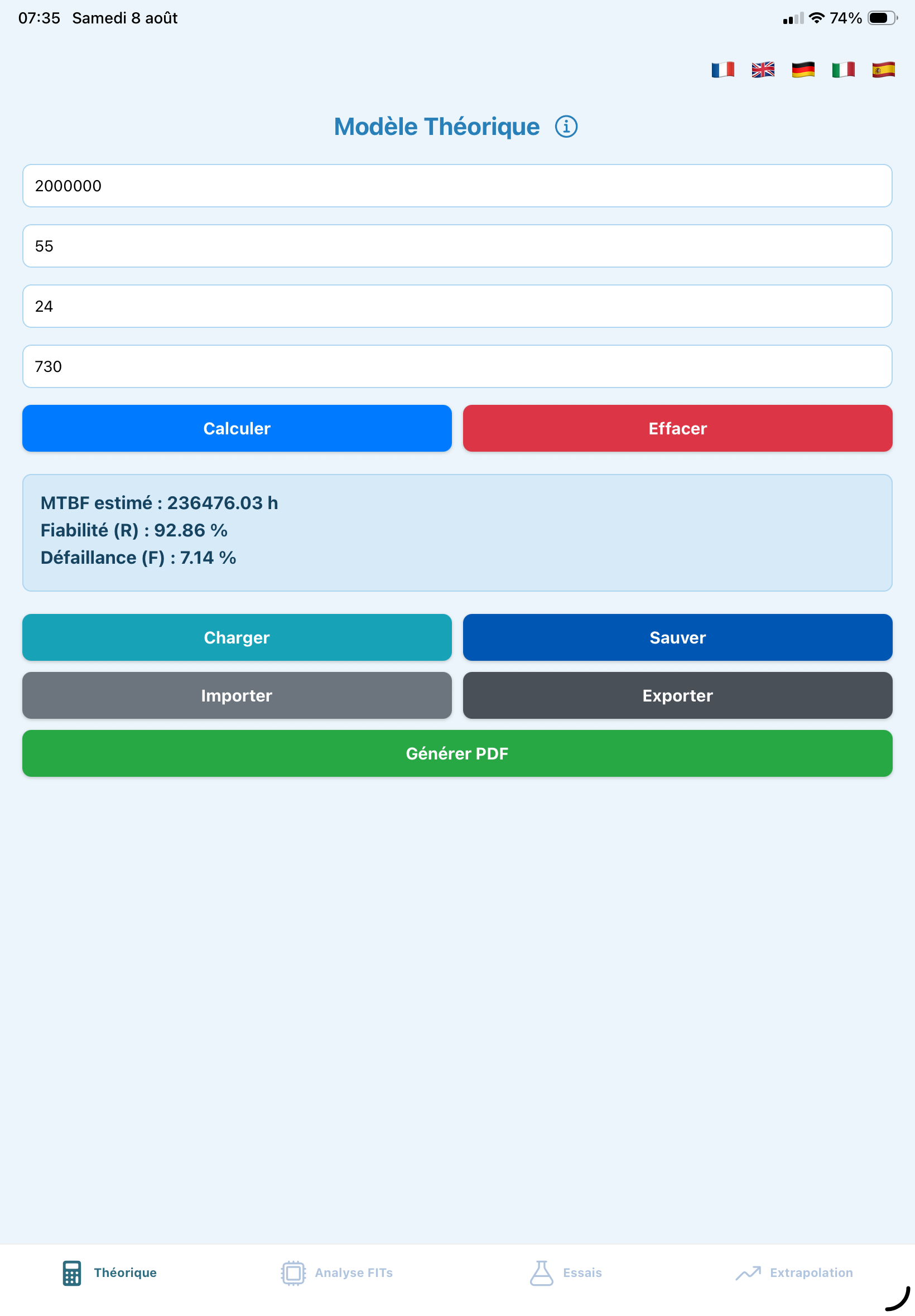
Theoretical Model
This method is ideal for commercial rack-mounted equipment (COTS). The manufacturer provides a calculated MTBF (Mean Time Between Failures) for ideal conditions (usually 25 °C). The role of the engineer is to use the system activation energy to downgrade this nominal MTBF based on the actual mission temperature in the field.
Example of application:
The documentation for an industrial food processing system indicates an MTBF of 150,000 hours at 25 °C. You plan to install it in an outdoor cabinet exposed to the sun where the temperature will be around 55 °C continuously for 1
year (or 8,760 hours).
Result:
The increase in temperature generates an Acceleration Factor (AF) of ~8.5. The MTBF drops drastically to 17,730 h. At the end of this first year, the reliability (probability of survival) drops to 61 %.
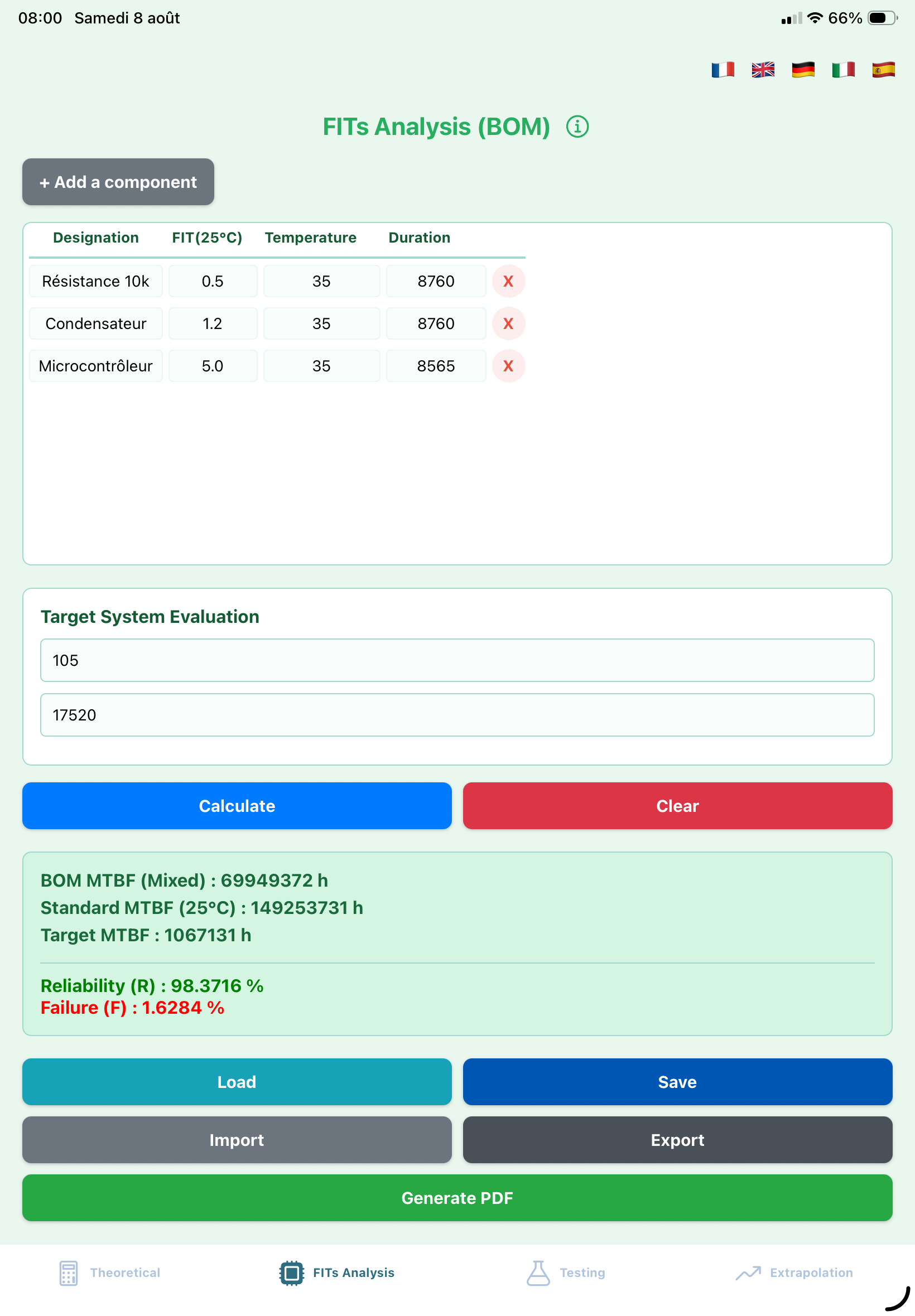
Analysis by FITs
Used during the R&D phase, this method consists of breaking down an electronic board into individual components. The FIT (Failures In Time) of each component is used. The calculation engine adjusts the FIT of each component according to its local heating, then sums the results to obtain the reliability of the complete system.
Example of application:
On a control board you have: 5 Resistors (1 FIT), 3 Capacitors (2 FIT), 4 Transistors (5 FIT) and 4 Diodes (3 FIT).
Result:
At 25 °C, the sum gives 43 FITs, representing an impressive MTBF of ~23 million hours. However, if this card is integrated in a 60 °C package, the components suffer. The overall system goes to ~507 FITs,
lowering the MTBF to 1.9 million hours.
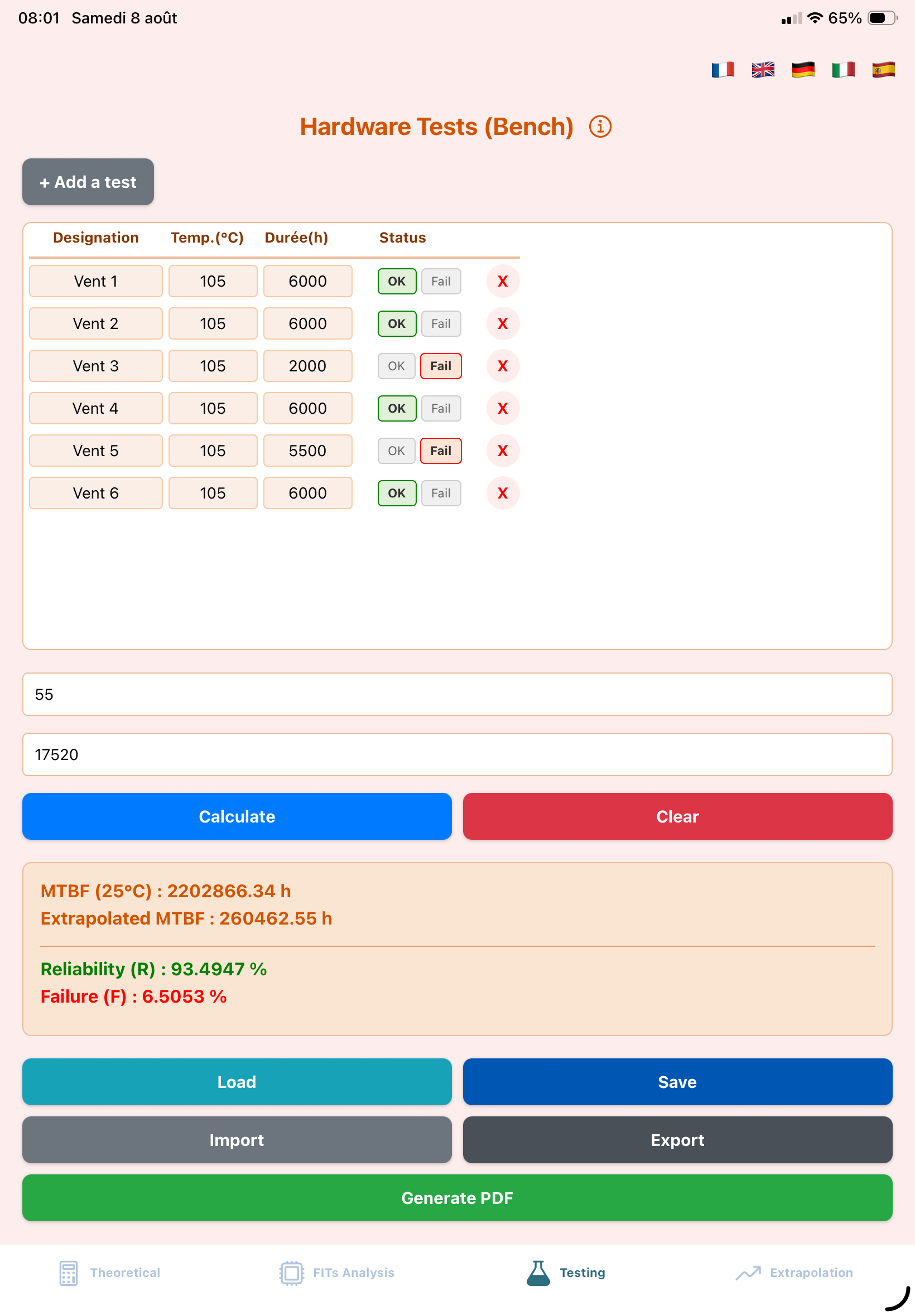
Material Tests
The theory must be confronted with the real world through accelerated life testing (ALT). The prototypes are placed in a thermal enclosure. The difficulty lies in the fact that some prototypes will fail, while others will survive, sometimes at different temperatures or durations. The method consists of mathematically converting all these heterogeneous hours on a common 25 °C basis to extract the actual physical MTBF.
Example of application:
You test 30 prototype engines. 27 engines survive successfully at 2,000 hours at 105 °C. However, 3 engines fail at 1,250 hours, 850 hours, and 1,127 hours. Your client will operate these engines at 55 °C.
Result:
The test accumulated 57,227 hours of raw thermal stress for 3 failures, representing a MTBF of 19,075 h at 105 °C. Extrapolated to the 55 °C of the customer, the validated actual MTBF is ~315,000 h.
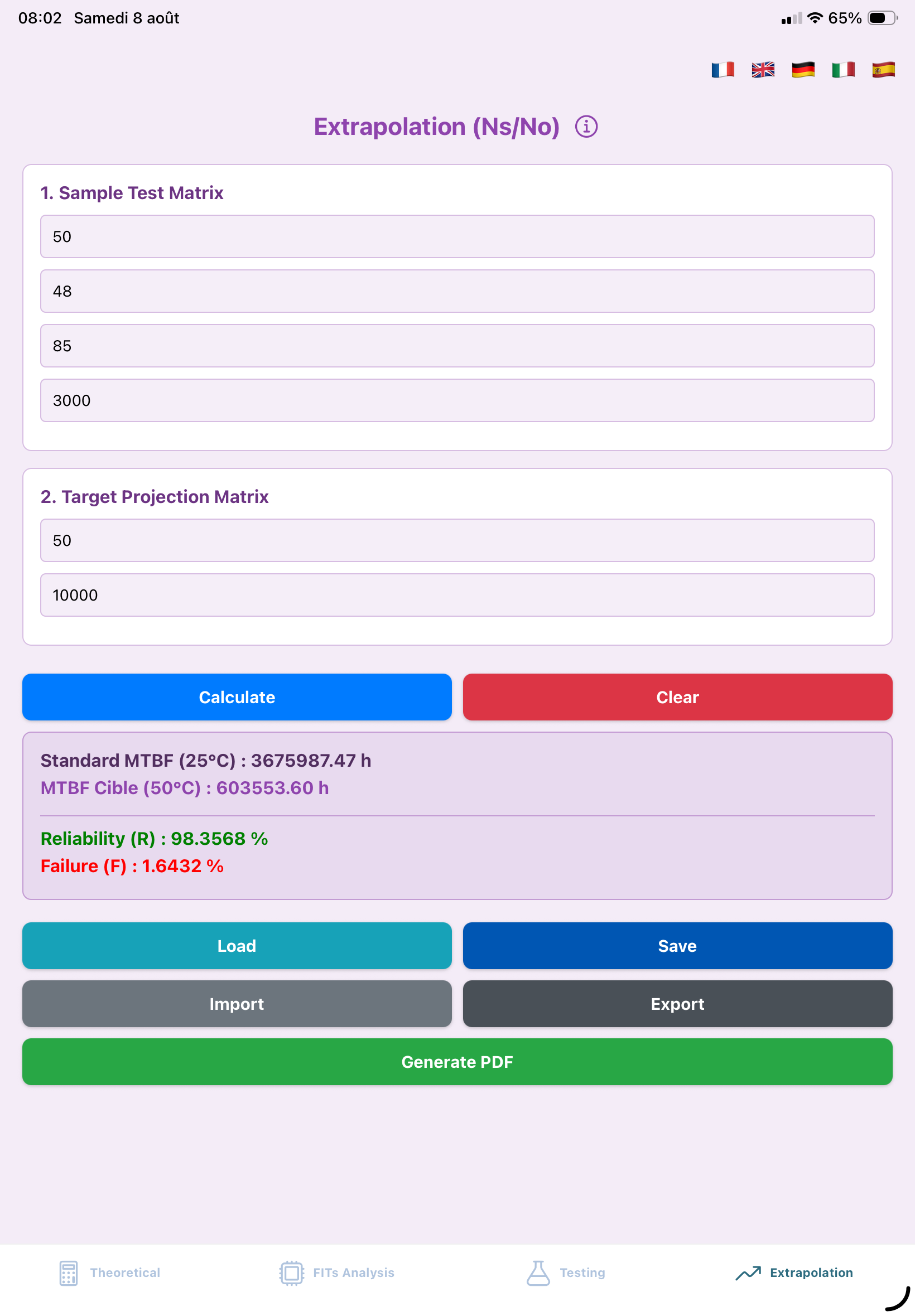
Extrapolation
Designed to verify contractual requirements, this method is based on the exact probability of survival of a sample according to the formula: MTBF = -t/ln(Ns/No) (where No is the initial population, Ns are the survivors, and t is the duration of the test). It allows a customer to certify that a production batch will meet its long-term objectives by testing it only for a short period at high temperature.
Example of application:
Your customer requires a survival rate of 95 % out of 10,000 hours at 50 °C. To prove it, you test 50 units (No). At the end of a thermal stress test at 85 °C for 3,000 hours, you have 48 functional units (Ns) left.
Result:
The MTBF of the test is ~73,490 h at 85 °C. By projecting this result to the 50 °C of the final application, the MTBF reaches ~603,560 h. The reliability over 10,000 h will therefore be 98.36 %. The customer’s specifications are formally respected and mathematically proven.